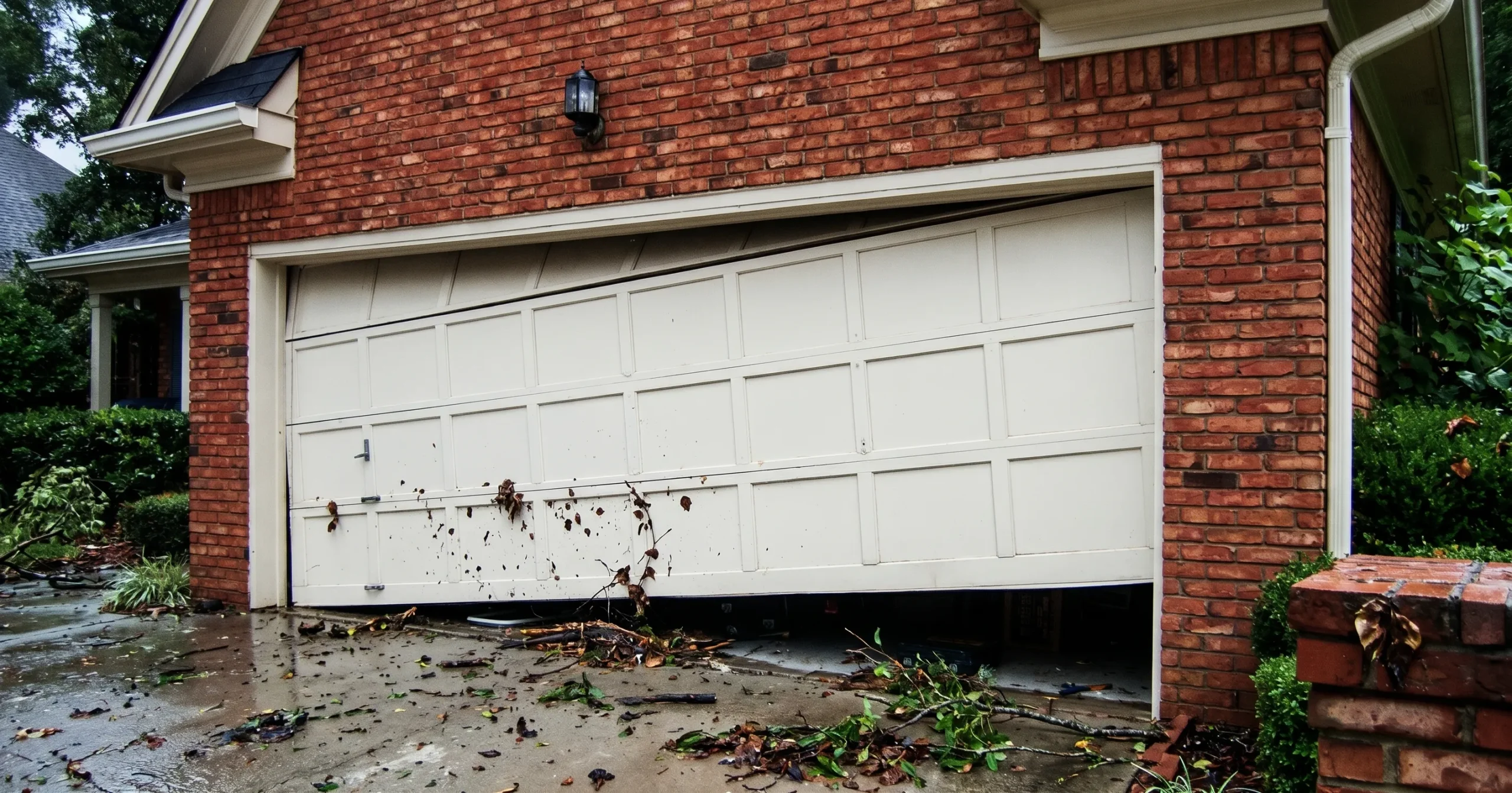
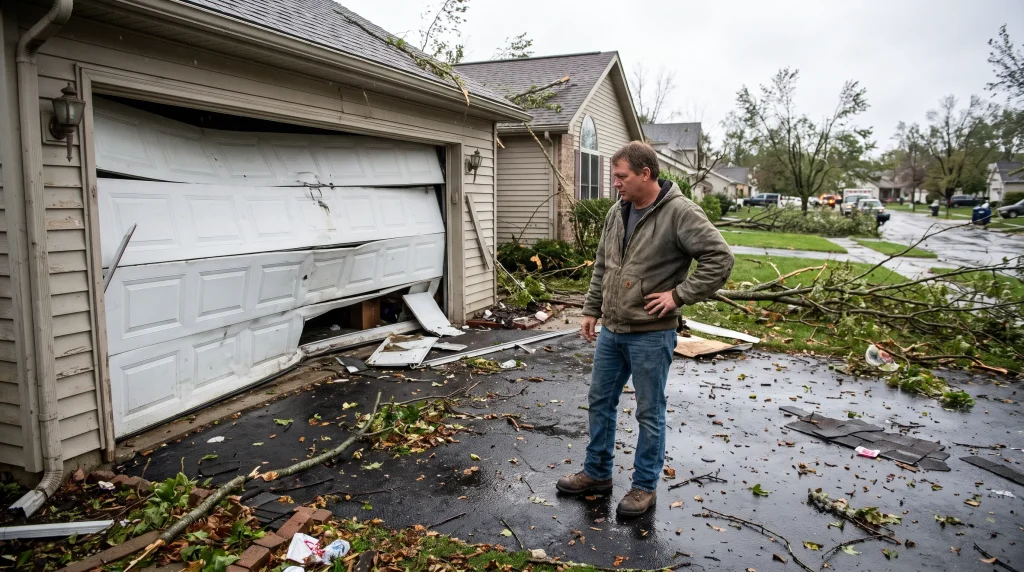
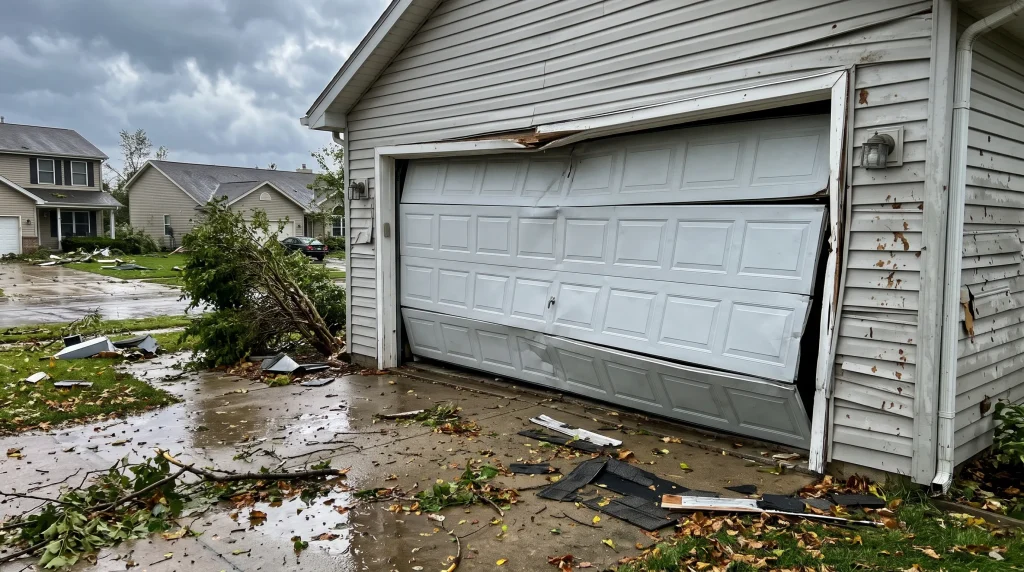
If a storm damaged your garage door, stop before you press the opener button. Look at the door first. If a panel is caved in, the door sits crooked in the opening, a cable has come loose, or you can see a gap where the door meets the track, do not run the opener. Running a damaged door is what turns a panel repair into a full door replacement, and it is how people get hurt. Take photos, unplug the opener, secure the opening as best you can, and call for emergency service. The eight steps below are the exact order our technicians walk homeowners through on the phone.
Key takeaways
- Do not operate a storm-damaged door. One press of the button can bend tracks, snap cables, and turn a repairable door into a replacement.
- Wind causes most severe garage door damage, not rain. Pressure on the large door panel is the failure point, and that failure often spreads to the roof.
- Photograph everything before you touch it. Insurance adjusters need the damage as it happened, not after a cleanup.
- Know where your emergency release is before you need it. In a power outage, that red handle is the difference between getting your car out and being stuck.
- A crooked door is an emergency, not a wait-until-Monday problem. Doors that come off track are under load and can fall.
- Springs and cables are never DIY. Everything else on this list is safe for a homeowner to check.
1. Look at the whole door before you touch anything
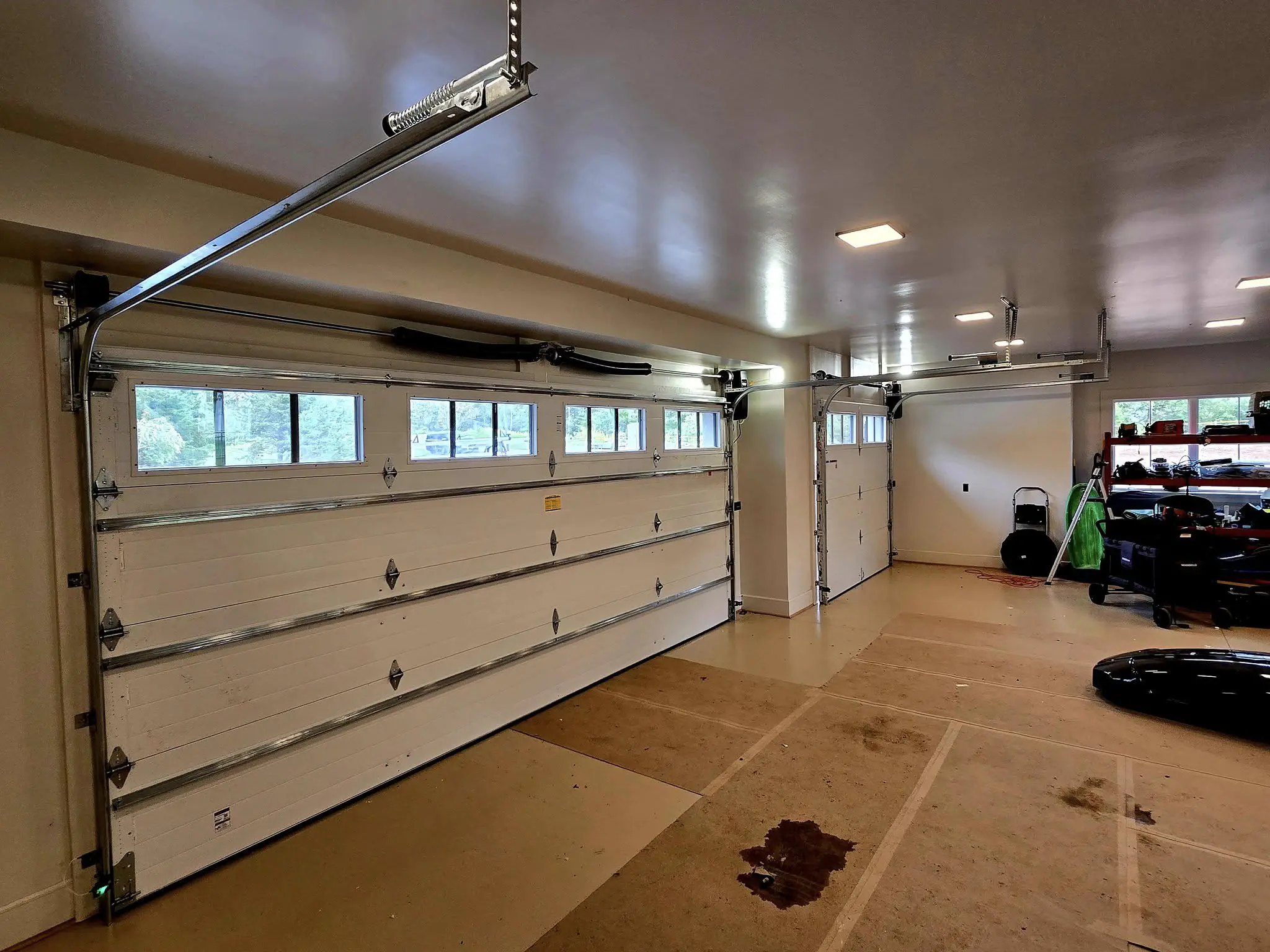
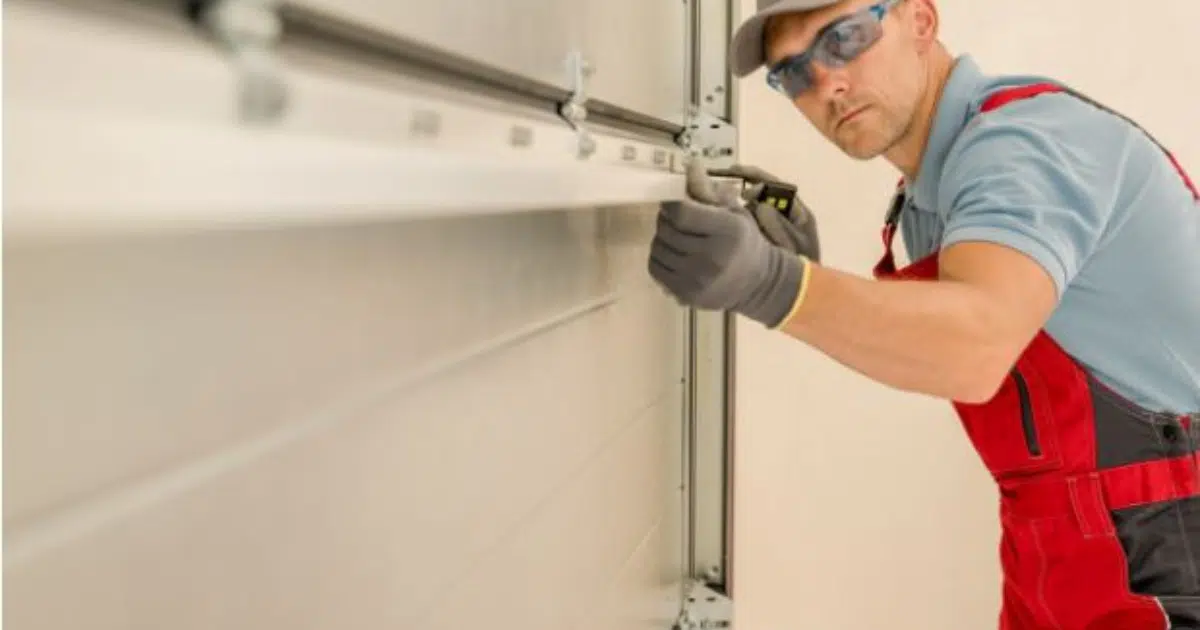
Start with a walk-around, not the opener button. Stand outside the closed door and look at it as a whole. Then step into the garage and look at the same door from the inside, where most of the mechanical damage actually shows.
Most likely cause: Storm damage is rarely limited to the thing you noticed first. A dented bottom panel usually means the rollers took a hit too. A door that looks fine from the street may have a bent track or a cable off its drum on the inside.
What to check:
- Panels, for dents, cracks, or separation at the seams
- The tracks on both sides, for bends, kinks, or pulled-away brackets
- The cables running up each side, for slack or fraying
- The springs above the door, for a visible gap in the coil
- The floor, for water, debris, or hardware that has fallen
Call a pro if: you see anything on that list. In our experience, homeowners underestimate storm damage roughly as often as they overestimate it, and the underestimates are the expensive ones. Waiting rarely helps here, and delaying a garage door repair in San Antonio usually widens the damage rather than holding it steady. If the walk-around turns up anything structural, that is a garage door repair call, not a weekend project.
How to inspect a garage door after a storm without making the damage worse
Keep the door closed for the inspection. Use a flashlight instead of pulling on anything. Do not push, lift, or lean on a door you suspect is damaged, and keep children and pets out of the garage until you know what you are dealing with.
2. Do not operate the door if you see any of these signs
Certain damage means the opener stays off, full stop. This is the single most important step on the page, and it is the one homeowners skip most often.
Do not run the door if you see:
- A gap in the spring coil above the door, or two pieces where there was one
- A cable hanging loose, coiled on the floor, or wrapped around the drum unevenly
- The door sitting visibly crooked in the opening, higher on one side than the other
- A roller sitting outside its track
- A panel bowed inward or split
Why it matters: A garage door is the heaviest moving object in most homes, and it is held in balance by springs under extreme tension. When one of those parts fails, the balance is gone and the load transfers somewhere it was never meant to go. Lifting a garage door with a broken spring is how people end up with crushed fingers and doors on the floor.
What to do instead: Unplug the opener or switch off its breaker so nobody in the house presses the button out of habit. Then leave the door where it is.
Call a pro if: any of the five signs above are present. Spring work in particular is never a homeowner job. Our rule of thumb from the field is simple: if it stores energy or carries the door’s weight, a technician touches it. If you are unsure what you are looking at, the signs that a garage door spring needs repair are worth knowing before storm season, and garage door spring repair is a same-visit fix for a trained tech.
Why you should not open a garage door with a broken spring after a storm
The spring, not the opener, does the lifting. An opener motor is sized to guide a balanced door, not to haul a hundred and fifty pounds of steel on its own. Force it and you strip the gears, bend the top section, or drop the door.
3. Check for wind damage, which is usually worse than it looks
Wind is what actually destroys garage doors in South Central Texas, and the damage frequently extends past the door itself. The door is the largest opening in the house, so it takes the most pressure.
Most likely cause: Pressure, not impact. A garage door can be pushed inward by wind hitting the front of the house or pulled outward by suction on the other side. Research from the Insurance Institute for Business and Home Safety attributes garage door failures in high wind to flying debris, positive and negative pressure, weak tracks, and doors that were not adequately fastened to the building, and notes that when the door goes, damage to the adjacent roof and walls often follows.
What to look for:
- Panels bowed inward or pulled outward at the center
- Track brackets loosened or pulled from the jamb
- A door that has shifted sideways in the opening
- Struts or reinforcement bars that have bent or detached
Fix steps: None of this is homeowner-serviceable. Photograph it, leave the door closed, and get a technician out. If the damage is confined to one or two sections, garage door panel replacement is often cheaper than a full door, though it is worth knowing that a damaged panel can create safety issues well beyond the cosmetic dent you can see.
Call a pro if: the door is off track or crooked. This is one of our most common calls the morning after a line of storms moves through, and it has its own set of causes worth understanding. We cover them in Why Do Garage Doors Go Off Track After Storms? 6 Causes and What to Do First. If it is already off, do not attempt to reseat it yourself, though how to fix a garage door off track explains what the repair involves.
How to tell if wind damaged your garage door or just moved it
Close one eye and sight down the face of the door from the side. A wind-damaged door will show a bow or a twist along its length. A door that simply shifted will look flat but sit unevenly in the opening. Either way the diagnosis happens with your eyes, not by running the door.
4. Check for water damage, including the parts you cannot see
Rain damage shows up slower than wind damage and gets ignored longer. Water that pushed under the door during a storm does not just dry and disappear.
Most likely cause: Wind-driven rain. Rain falling straight down rarely gets past a garage door. Rain moving sideways at forty miles an hour finds every gap in the bottom seal, the side weatherstripping, and the threshold. Guidance from the U.S. Department of Energy’s Building America Solution Center points to head flashing and threshold sweeps as the details that keep wind-driven rain out of door openings, and the same principle applies at the garage.
What to check:
- Standing water inside the garage, especially along the door line
- A bottom seal that is cracked, flattened, or torn away
- Rust forming at the bottom of the door sections
- Water stains on stored boxes or drywall near the opening
- The opener unit and any outlet that may have taken water
Fix steps: Dry the floor, move anything stored on it, and inspect the seal. Replacing a worn seal is genuinely a homeowner job, and the easy way to replace a garage door bottom seal walks through it. Side and top gaps are handled by garage door weather stripping.
Call a pro if: the concrete has settled and the door no longer meets the floor evenly, or water reached the opener. There are more entry points than most people expect, which is the subject of Can Heavy Rain Damage Your Garage Door? 7 Ways Water Gets In.
Why water keeps getting under a garage door after heavy rain
Nine times out of ten it is the bottom seal, and the reason it failed is Texas heat rather than the storm. Sun bakes the rubber all summer until it hardens and stops conforming to the floor. The storm just revealed it.
5. If the power is out, handle the opener safely
A garage door opener that will not respond after a storm is usually a power problem, not an opener problem. Confirm that before assuming the unit is dead.
Most likely cause: The outage itself, a tripped GFCI outlet, or a surge that took out the logic board. Openers on the same circuit as an outdoor outlet are the usual casualties.
Fix steps:
- Check whether the rest of the garage has power. Test the light on the opener and a nearby outlet.
- Check the breaker panel and reset anything tripped.
- Check the GFCI outlet the opener is plugged into, since these trip on moisture and reset with a button.
- If power is restored and the opener still does nothing, note whether the lights blink, which tells a technician a lot.
Openers behave in specific ways after an outage, and a garage door opener not working after a power outage is common enough that it is worth checking before you call. While you are looking, glance at the safety sensors near the floor. Storm debris knocks them out of line constantly, and checking whether your garage door sensors are aligned takes about a minute.
Call a pro if: power is confirmed and the unit is still unresponsive, or you smell anything burnt. A surge-damaged board is a replacement, not a repair, and a technician can tell you quickly whether a new garage door opener makes more sense than fixing the old one.
Why a garage door opener stops working after a storm in San Antonio
Surges are the quiet culprit. A nearby strike does not have to hit the house to push enough voltage through the line to kill a logic board. If the opener was fine before the storm and dead after, with power confirmed, assume the board took it.
6. Use the emergency release the right way
The red handle hanging from the opener rail disconnects the door from the opener so you can move it by hand. It is not a repair tool. Used at the wrong moment, it drops the door.
When to use it: The power is out, the door is intact and balanced, and you need to get a vehicle in or out.
How to use it:
- Make sure the door is fully closed first, if at all possible. Pulling the release while the door is partly open removes the only thing holding it up.
- Clear the path under the door completely.
- Pull the handle straight down until the carriage disconnects.
- Lift the door from the bottom center with both hands, evenly. A balanced door should feel like forty to fifty pounds, not two hundred.
- To reconnect, close the door, pull the handle toward the opener, and run the opener once so the carriage relatches.
When not to use it: If a spring is broken, a cable is loose, or the door is off track, the release does not help. It removes the opener from the equation and leaves the full weight of the door on whatever is left. Cables in particular fail quietly, and garage door cable condition affects the whole system more than most homeowners realize.
Call a pro if: the door feels heavy when you lift it, will not stay put when you stop halfway, or drops when you let go. All three mean the spring system is not holding.
How to safely use a garage door emergency release during a power outage
The whole safety of this procedure rests on one condition: the door must be balanced. Balanced means it stays where you stop it. If it does not, put it down, leave it down, and wait for a technician.
7. Photograph everything and start the insurance conversation
Document the damage before you clean up anything. Adjusters work from evidence, and the evidence disappears fast once you start sweeping.
What to capture:
- Wide shots showing the whole door and the front of the house
- Close-ups of each damaged panel, track, and bracket
- The interior of the garage, including any water line on the floor
- Anything stored in the garage that was damaged
- A time-stamped photo if your phone supports it
What to do next: Call your insurer and ask specifically whether the damage falls under wind, hail, or flood, because they are treated differently. Most standard homeowners policies cover wind and falling debris. Flooding usually is not covered without a separate policy. Whether homeowners insurance covers garage doors depends heavily on how the loss is classified.
One honest note: Ask your technician for an itemized written estimate rather than a lump sum. Adjusters approve line items faster than totals, and in our experience the itemized estimate is the single thing that speeds up a garage door claim.
Call a pro if: you need the estimate before the adjuster visit, which is the usual sequence. Make only temporary repairs until the claim is settled, and save every receipt.
What insurance covers for storm damage to a garage door
Wind damage and impact from flying debris are typically covered. Rising water is typically not. Gradual rust, worn seals, and wear that predates the storm will be excluded, which is another reason the photos matter.
8. Book emergency service, and know what “same-day” should mean
A storm-damaged door is a security problem as much as a mechanical one. An opening you cannot close is an open door to your house.
What to do while you wait:
- If the door will not close, do not leave the garage unattended if you can avoid it
- Move valuables and tools out of reach of the opening
- If a vehicle is trapped inside, tell the dispatcher, since it changes the priority
- Keep the area under the door clear so the technician can work immediately
What to ask when you call:
- Whether the company carries common parts on the truck, since that decides whether it is one visit or two
- Whether the quote covers parts and labor
- Whether the technician is licensed and insured, which matters more after a storm than at any other time, because storm season brings out-of-town operators. It is worth knowing how to check that a garage door company is licensed and insured before anyone touches the door.
Call a pro if: the door will not close, the door is off track, a spring is broken, or a vehicle is trapped. Those four are true emergencies and should not wait. If you are north of the city, the same rules apply with a few local wrinkles, which we cover in Need Emergency Garage Door Repair in Boerne? 7 Things to Do Before Help Arrives.
What counts as an emergency garage door repair in San Antonio
An emergency is anything that leaves your home unsecured, traps a vehicle, or puts weight on a failed component. A dent you do not like the look of is not an emergency. A door hanging at an angle is.
Storm damage: what you can handle and what needs a technician
Situation | Safe to handle yourself | Call a technician | Why |
Worn or torn bottom seal | Yes | Optional | Low risk, no stored energy involved |
Debris in the tracks | Yes, with the door closed and opener unplugged | If the track is bent | Clearing debris is safe, straightening steel is not |
Misaligned safety sensors | Yes | If they still will not align | A simple realignment is a five-minute job |
Opener unresponsive, power confirmed | No | Yes | Likely a surge-damaged board |
Dented or cracked panel | No | Yes | Section swaps require the door to be unloaded |
Door sits crooked or off track | No | Yes, urgently | The door is under uneven load and can fall |
Broken or gapped spring | Never | Yes, urgently | Extreme stored energy, serious injury risk |
Loose, frayed, or dropped cable | Never | Yes, urgently | The cable is holding the door’s weight |
Door will not close, home unsecured | No | Yes, same day | Security risk plus likely mechanical failure |
If you are weighing the cost of the call against waiting, the general question of what a garage door company charges is worth reading before the storm, not after.
The short version
Storms do not usually break a garage door in one clean way. They bend something, loosen something else, and leave a door that still moves but should not. The homeowners who come out of storm season cheapest are the ones who looked before they pressed the button, left the springs and cables alone, and got a technician out the same week instead of the same month. A seasonal garage door maintenance routine before the next round of storms is the cheapest insurance there is.
If a storm has damaged your door, Lincoln Garage Doors LLC offers same-day emergency service across San Antonio and the surrounding Hill Country communities. Our licensed technicians carry springs, cables, rollers, and common panel hardware on the truck, so most storm calls are handled in a single visit.
Request same-day emergency service or a free written estimate. Tell the dispatcher if a vehicle is trapped or the door will not close, and we will prioritize the call.