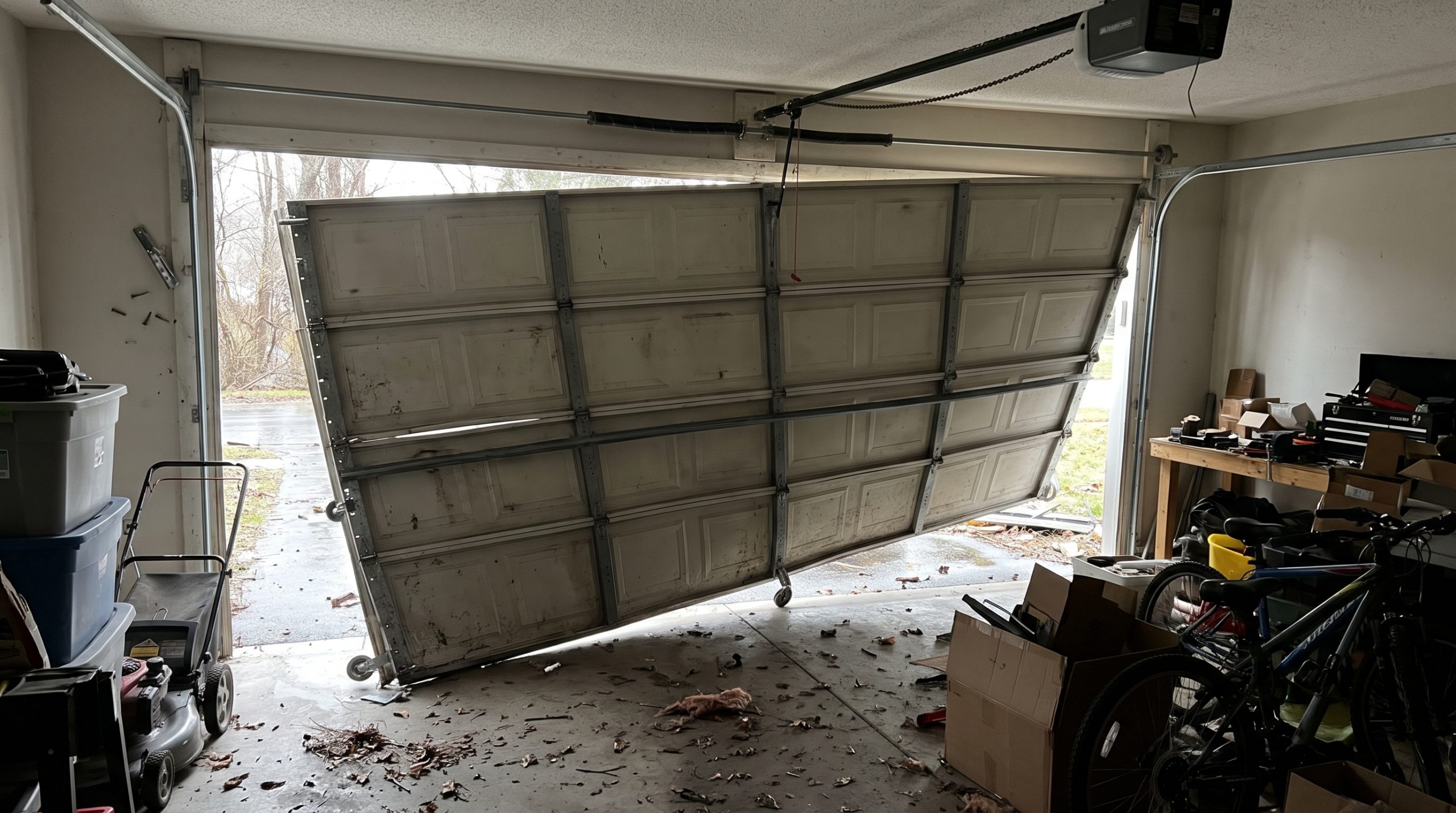
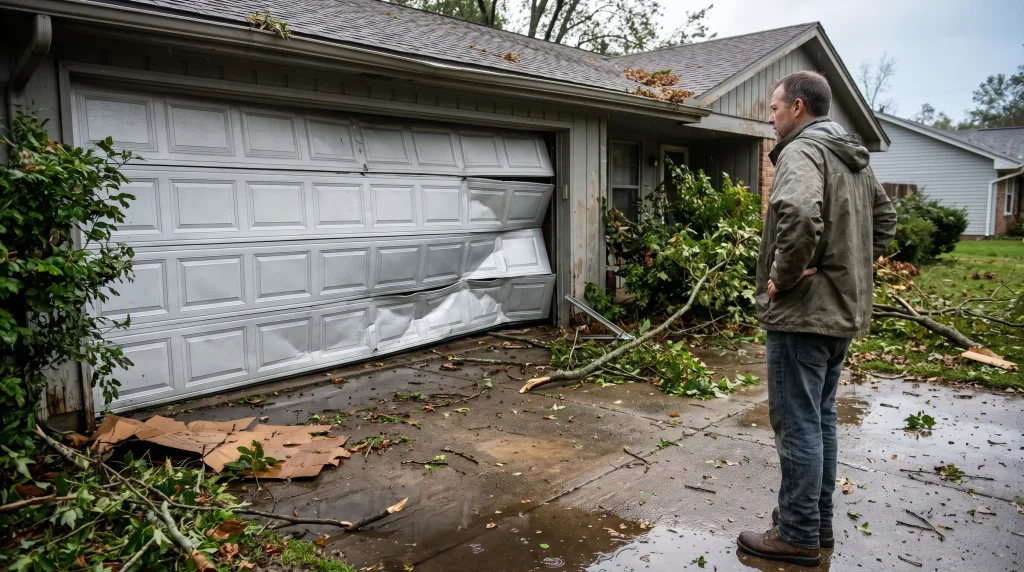
A garage door comes off track after a storm because wind pressure, flying debris, or a failed part pulled the rollers out of their guides. Wind is the usual cause in South Central Texas, and it does not have to hit the door directly. Suction on the back side of a house pulls the door outward hard enough to lift rollers out of the track. What you do in the next ten minutes matters more than the diagnosis: stop using the door, unplug the opener, keep everyone out from under it, and call for service. A door that is off track is carrying its weight unevenly and can fall.
Key takeaways
- Do not run the opener. One cycle on a derailed door bends tracks, snaps cables, and can drop the door.
- Wind pressure causes more off-track doors than impact does. Suction pulls, it does not only push.
- A crooked door is an emergency, not a Monday problem. The load is uneven and the door is unstable.
- Reseating a roller is not a DIY job. The door is under spring tension the whole time.
- Look for the cause, not just the symptom. A door that jumped the track usually had a worn roller or a loose bracket first.
- Photograph it before anyone touches it if you plan to file an insurance claim.
What to do first, before you diagnose anything
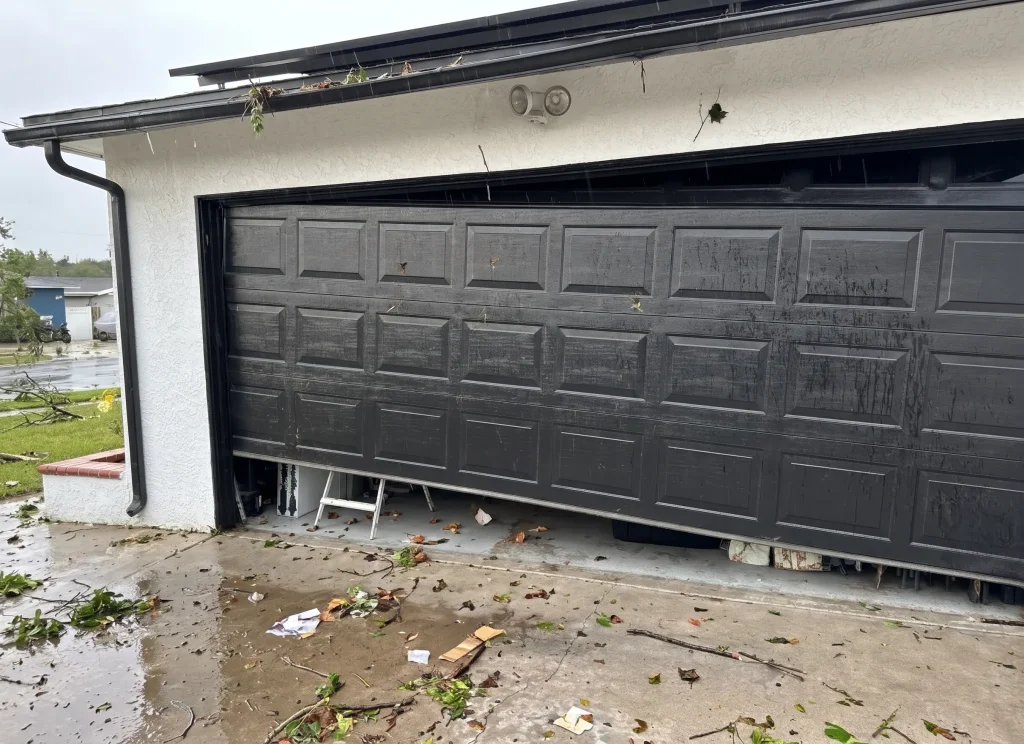
Stop. Unplug. Stand back. In that order, and before you look for a cause.
- Do not press the button again. If the door is crooked, stuck, or visibly out of its guides, every further cycle does more damage. This is the single most expensive mistake homeowners make, and it turns roller jobs into track-and-panel jobs.
- Unplug the opener or switch off its breaker. Not because the opener is at fault, but because somebody in the house will press that button out of habit.
- Do not pull the emergency release. On a door that has come off track, the release removes the opener from the equation and leaves the full weight resting on whatever is still holding. Learn how the release works on your garage door opener before you need it, and know when not to use it.
- Clear the area under and around the door. Move vehicles if it is safe to do so, and keep children and pets out of the garage.
- Photograph the damage from several angles before anything is moved.
- Call for service. If you want to understand what the repair involves, how to fix a garage door off track explains the process, though it is a technician job in nearly every case.
If the storm did more than derail the door, work through What Should You Do When a Storm Damages Your Garage Door? 8 Emergency Steps for San Antonio Homeowners for the full sequence.
What to do when a garage door comes off track after a storm
Nothing mechanical. The only actions that help are the ones that stop further movement and protect people. Everything else waits for a technician with the tools to unload the springs safely.
1. Wind pressure pulled the door out of its tracks
This is the most common cause, and it surprises people because there is often no visible impact. The door simply is not where it was.
Most likely cause: Pressure differential. A garage door is the largest opening in a house, so it takes more wind load than any window or entry door. Wind hitting the front pushes the door inward. Wind moving across or around the house creates suction that pulls it outward. Either direction can lift rollers out of their guides, and the outward pull is the one homeowners never expect.
What it looks like:
- The door sits proud of the opening at the top, or bowed at the center
- One or more rollers are visibly outside the track
- The top section is separated slightly from the section below it
- The door looks fine from the street but will not close flush
Why it matters beyond the door: Research from the Insurance Institute for Business and Home Safety found that homes whose garage doors stayed intact during high wind events were far less likely to suffer structural roof damage. When the door goes, the pressure that was pushing on it moves into the garage and up against the roof deck. The door is not just a door, it is part of the building envelope.
Call a pro if: any of the above is true, which is all of them. Wind-derailed doors need the tracks checked for straightness before anything is reseated, because putting a roller back into a bent track just guarantees a repeat.
How wind pulls a garage door off its track without hitting it
Suction. The same force that lifts an airplane wing acts on the flat face of your door when wind moves past the house. It pulls outward, the rollers lift, and the door leaves the guide. No debris required.
2. Debris struck the door or lodged in the track
The visible, obvious cause, and less common than wind. Something hit the door, or something small got into the track and jammed it mid-travel.
Most likely cause: Storm debris. A branch, a piece of fence, a trash can, or yard furniture. Impact at the center of a section bends the panel, and a bent panel no longer holds the rollers in a straight line. Alternatively, a small object lands in the horizontal track and the door climbs over it.
What to check, with the door closed and the opener unplugged:
- Run a flashlight along both vertical and horizontal tracks looking for debris
- Look for a dent that lines up with where the door binds
- Check whether the bottom bracket at either corner has been knocked out of position
- Look for gouges or scrape marks in the track, which show you where the roller was traveling wrong
Fix steps: Small, loose debris can be removed by hand with the door closed and the power off. That is the extent of safe homeowner intervention here.
Call a pro if: a panel is bent. Sections are structural, not cosmetic, and a bent one distorts the geometry that keeps rollers aligned. A bent garage door panel repair is sometimes possible on light damage, but once a section is creased through, garage door panel replacement is the durable answer.
Why a bent garage door panel makes the door come off track
Because the rollers are mounted to the sections, and the sections are what hold them square. Bend a section and the rollers on it no longer point where the track expects them to. The door climbs, binds, and eventually jumps.
3. A lift cable came off its drum or snapped
This is the cause most likely to leave the door hanging crooked. One side drops, the other stays, and the door wedges in the opening at an angle.
Most likely cause: Slack. If the door hits an obstruction on the way down, or lands hard, the cable on that side goes slack for a moment and can jump off the drum at the top. Once it is off, that corner of the door loses its support the next time the door moves. Corrosion is the other common contributor, and cables that have been sitting in a damp garage fail sooner.
What it looks like:
- The door is noticeably higher on one side
- A cable is hanging loose, coiled on the floor, or wrapped unevenly around the drum
- The door dropped suddenly and stopped at an angle
- You heard a bang during or after the storm
What to do: Nothing beyond keeping everyone away from it. The spring on that side is still fully loaded, and the door’s weight has shifted somewhere it was never designed to sit. Changing a garage door cable requires unloading the springs first, which is why it is on the never list for homeowners.
Call a pro if: you see a loose cable, full stop. This is a same-day emergency. If you are north of San Antonio, Need Emergency Garage Door Repair in Boerne? 7 Things to Do Before Help Arrives covers what to do while you wait for a technician.
Why a garage door hangs crooked after a storm
Because one side lost its cable and the other did not. The door is now supported at three points instead of four, and the corner that lost support is being held by the track alone, which was never meant to carry weight.
4. A broken spring let the door drop and skew
A spring failure and an off-track door often arrive together. The spring fails first, the door drops, and the impact pushes rollers out of alignment.
Most likely cause: Cycle fatigue, which the storm only revealed. Torsion springs are rated for a set number of open and close cycles, and a spring near the end of its life will break during an ordinary cycle just as readily as a dramatic one. Temperature swings accelerate it. So does rust.
What it looks like:
- A visible gap in the spring coil above the door, where a continuous coil used to be
- The door feels extremely heavy, or the opener struggles and stops
- A loud bang, often reported as sounding like a gunshot, during the storm or shortly after
- The door came down fast and landed hard
What to do: Leave it closed. Do not try to lift it, and do not run the opener to see if it still works. An opener motor is sized to guide a balanced door, not to lift one on its own, and forcing it strips gears and bends the top section.
Springs do not usually fail at random, even when it feels that way. There are specific reasons garage door springs break unexpectedly, and the stresses that shorten spring life are mostly predictable, which is why understanding what stress affects a garage door spring is worth ten minutes before storm season rather than after.
Call a pro if: you see a gap in the coil. Garage door spring repair is never a homeowner job. Our rule of thumb from the field is that anything storing energy or carrying the door’s weight is technician work every time, without exception.
How to tell if a broken spring or the track caused the problem
Look up before you look sideways. A gap in the spring coil is unmistakable and tells you the spring went first. If the springs are intact and the door is still crooked, the cause is further down: a cable, a roller, or the track itself.
5. Worn or corroded rollers jumped the guide
The quiet cause. The storm gets the blame, but the rollers had been failing for a year. A healthy roller spins. A dead one slides, and a sliding roller climbs out of the track under load.
Most likely cause: Bearing failure. Steel rollers with exposed bearings collect grit and moisture and eventually seize. Nylon rollers last longer but go brittle with heat and age. Once a roller stops rotating, it is dragging along the track rather than rolling, and any lateral force pops it out.
What to check, with the door closed and the power off:
- Spin each roller by hand. They should turn freely with no grinding
- Look for flat spots on the roller face, which mean it has been sliding
- Check the stems for rust or bending
- Listen during the next normal cycle, once the door is repaired, for grinding or a rhythmic clunk
Fix steps: Replacing garage door rollers is straightforward for a technician and quick, but the bottom rollers sit in brackets attached to the lift cables, which puts that corner under tension. That is the part homeowners underestimate.
Why they corroded: Usually water that has been getting into the garage for a while. Rollers sit at the bottom of the door where standing water collects, and Can Heavy Rain Damage Your Garage Door? 7 Ways Water Gets In covers how that water gets there in the first place. Heat does its own damage on a separate schedule, and Texas heat knocking garage door sensors loose is a reminder that summer works on every component, not just the obvious ones.
Call a pro if: any roller will not spin freely. Replace them as a set rather than one at a time, since they have all aged together.
Why old rollers cause a garage door to come off track in a storm
Because a seized roller has no margin. A healthy roller absorbs a little flex and stays in the guide. A roller that is already dragging is sitting at the edge of its tolerance, and the extra force from wind is simply what finally pushed it out.
6. Track brackets loosened or the jamb shifted
The structural cause, and the one most often missed during a quick repair. The track is only as straight as the wood it is bolted to.
Most likely cause: Years of vibration loosening lag bolts, sometimes combined with wood that has softened from moisture. Storm wind then pulls against brackets that were already only half holding. In older San Antonio homes, foundation movement can also shift the jamb enough to throw the vertical tracks out of plumb.
What to check:
- Look at each track bracket where it fastens to the jamb, and note any that are pulled away or have visible gaps
- Check whether the vertical tracks are parallel by measuring the gap between them at the top and at the bottom
- Look for elongated bolt holes, which mean the bracket has been moving
- Press on the wood around each lag bolt. Soft wood will not hold a repair
Why the track matters more than people think: Garage doors are engineered as systems, and the attachment to the building is part of the rating. Guidance from the U.S. Department of Energy’s Building America Solution Center explains that garage doors carry a design pressure rating and that resisting wind depends on the door, its tracks, and its attachment to the structure working together. A perfectly good door bolted to a loose jamb is not a rated assembly.
Call a pro if: brackets are loose or the tracks are not parallel. Re-tightening a lag bolt into stripped wood is a temporary fix at best. A proper garage door repair here means new fasteners, sometimes new jamb material, and a track alignment check afterward.
Most of this is preventable. Effective garage door maintenance to maximize lifespan catches loose hardware and failing rollers long before a storm finds them, and timely garage door repair on the small stuff is what keeps the big stuff from happening at the worst possible moment.
How to check if garage door tracks are still aligned after a storm
Measure the gap between the vertical tracks at the top and again near the floor. The two numbers should match. If they do not, the tracks have splayed or pinched, and no amount of reseating rollers will hold until that is corrected.
What you can do safely and what needs a technician
Situation | Safe to handle yourself | Call a technician | Why |
Loose debris sitting in the track | Yes, with the door closed and power off | If the track is dented | Removing an object is safe, straightening steel is not |
Roller out of the track | No | Yes, urgently | The door is under spring tension throughout |
Door hanging crooked | No | Yes, urgently | Uneven load, the door can fall |
Loose or snapped cable | Never | Yes, urgently | The cable carries the door’s weight |
Broken spring | Never | Yes, urgently | Extreme stored energy, serious injury risk |
Bent or creased panel | No | Yes | Sections are structural and hold roller alignment |
Seized or flat-spotted rollers | No | Yes | Bottom rollers sit under cable tension |
Loose track bracket | No | Yes | Needs sound fastening and an alignment check |
Opener struggling on a derailed door | No, stop using it | Yes | Every cycle compounds the damage |
Photographing damage for insurance | Yes | No | Do this before anyone touches anything |
Costs vary by which part actually failed, and the cable scenario is a useful benchmark since it is one of the most frequent storm repairs. What it costs to fix a broken cable on a garage door gives you a sense of the range before you call.
The short version
Doors rarely come off track because of one dramatic gust. They come off because a roller was already seized, or a bracket was already loose, and the storm supplied the last bit of force. That is good news, because it means the failure is preventable with a twice-yearly look at the hardware. What is not negotiable is what happens afterward. Once the door is off its track, it is unstable, and the only safe move is to stop using it. If you are hiring for the repair, the questions to ask before hiring a garage door company matter more after a storm than at any other time, because widespread damage brings out-of-town operators into the area.
If your door is off track right now, Lincoln Garage Doors LLC provides same-day emergency service across San Antonio and the surrounding Hill Country. Our licensed technicians carry rollers, cables, springs, and track hardware on the truck, so the majority of off-track calls are resolved in a single visit.
Request same-day emergency service or a free written estimate. Tell the dispatcher if the door is hanging crooked or a vehicle is trapped inside, and we will prioritize the call.