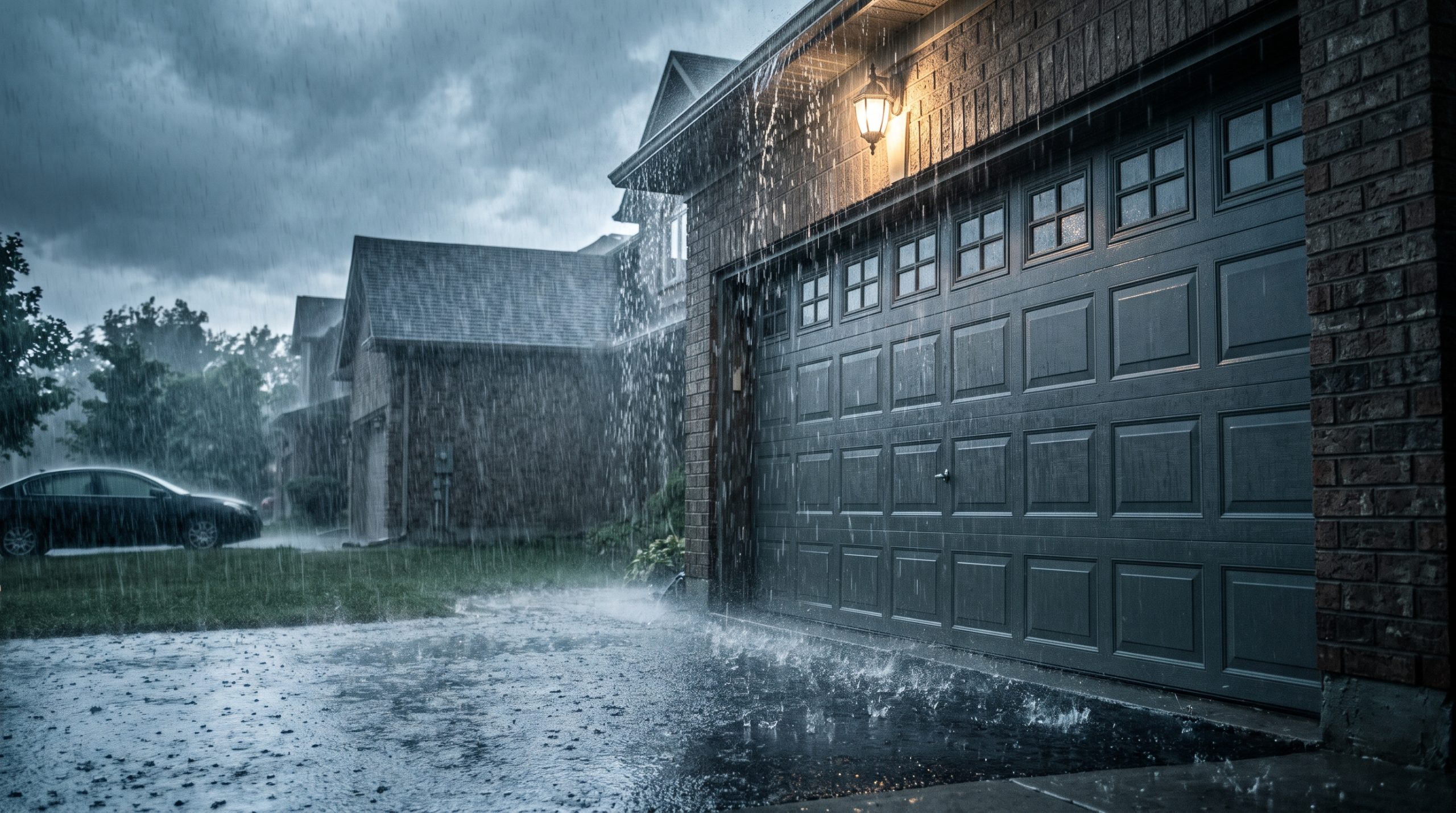
Yes. Heavy rain damages garage doors, and in San Antonio it usually does it slowly enough that homeowners miss it until something stops working. Rain falling straight down rarely gets past a closed door. Rain driven sideways by wind finds every hardened seal, every gap in the side weatherstripping, and every low spot in the slab. Once water is inside, it rusts the bottom section, corrodes rollers and cables, and eventually reaches the opener. The good news is that most entry points are visible from inside your own garage on a dry day, and two of the seven are genuinely fixable in an afternoon.
Key takeaways
- The bottom seal is the culprit about nine times out of ten, and Texas heat, not the rain, is what killed it.
- Wind is what turns rain into a problem. Sideways rain gets past seals that handle vertical rain fine.
- Water damage shows up as rust, not puddles. By the time you notice the rust, water has been getting in for months.
- Two fixes are safe DIY: replacing the bottom seal and replacing side weatherstripping. The rest are not.
- A door that will not close fully is a water problem and a security problem. Do not ignore a gap at the bottom.
- If the slab has settled, no seal will fix it. That needs a threshold or a concrete solution, not more rubber.
1. The bottom seal has hardened and no longer meets the floor
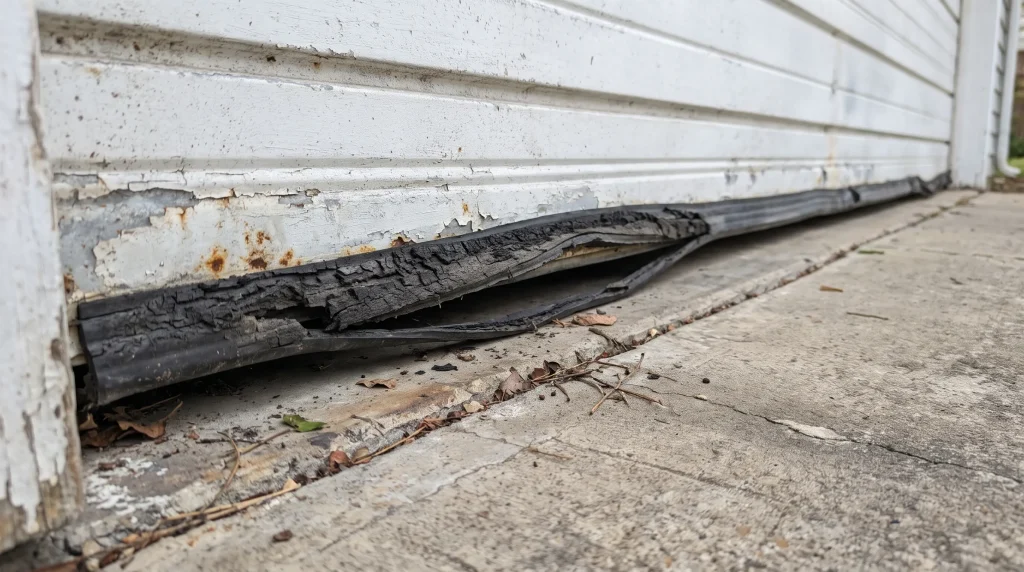
This is the first place to look and the most common answer. The bottom seal, sometimes called the astragal, is the flexible strip along the bottom edge of the door that squashes against the concrete when the door closes.
Most likely cause: Heat, not water. San Antonio summers bake that rubber or vinyl until it stiffens and takes a permanent set. A hardened seal no longer conforms to the small irregularities in the floor, so it bridges across them and leaves channels for water.
How to check it:
- Close the door and stand inside the garage in daylight with the lights off.
- Look along the bottom edge. Daylight showing through means water can get through.
- Press a finger against the seal. It should give easily. If it feels like a garden hose rather than a squeegee, it is done.
- Pull the seal down slightly and look for cracks along the folds.
Fix steps: Most residential seals slide out of a retainer track at the bottom of the door and a replacement slides straight back in. Replacing a garage door seal is one of the few garage door jobs a homeowner can do safely, because nothing in the process is under tension.
Call a pro if: the retainer track itself is bent, rusted, or torn away from the door. That is a hardware repair, not a seal swap. While you are down there, look at the rollers. Standing water at the bottom of the door corrodes the bearings first, and replacing garage door rollers is usually the fix once they start to seize.
How to tell if your garage door bottom seal is letting water in
The daylight test settles it. If you can see light under a closed door, you have a water path. If you cannot see light but water still comes in, the seal is fine and the problem is somewhere else on this list.
2. The side and top weatherstripping has pulled away
Water does not only come in at the bottom. The vertical strips along both sides of the opening and the strip across the top are just as important, and they fail more quietly.
Most likely cause: The nails or staples holding the stop molding to the jamb work loose over years of vibration. The molding pulls back a quarter inch, and that is enough. Sun exposure on the west-facing side of a house does the rest.
How to check it:
- Run your hand down the inside of each side jamb where the door meets it
- Look for daylight at the corners, which is where separation starts
- Check whether the rubber flap is still making contact with the door face, not just sitting near it
- Look for water staining on the jamb itself, which shows you where it has been running
Fix steps: Side and top weatherstripping is nailed or screwed to the wood stop molding and comes off with a pry bar. Cut the replacement slightly long and work from the bottom up so each piece overlaps the one below it. Installing garage door weather stripping walks through the sequence.
Call a pro if: the wood stop molding itself is rotted. Nailing new rubber to soft wood buys you one season at most.
Why water runs down the sides of a garage door during heavy rain
Because the vertical seal is the only thing between the door face and the jamb, and it works by contact rather than by pressure. Once it stops touching the door, it stops sealing, even though it still looks like it is in place.
3. The slab slopes toward the garage or the concrete has settled
Sometimes the door is fine and the ground is the problem. If water is pooling against the outside of the door before it comes in, no seal on earth will hold it back indefinitely.
Most likely cause: Two things, usually together. Driveways are supposed to slope away from the garage, and many older San Antonio driveways have settled enough that they no longer do. Separately, the garage slab itself can settle along its edge, leaving a low spot under the door that collects water.
How to check it:
- Watch the driveway during the next hard rain and see which way the water actually travels
- After the rain stops, look for a puddle that sits against the door rather than draining away
- Slide a coin under the closed door at several points along its width. If it disappears in the middle but not at the ends, the slab has dipped
Fix steps: This is not a seal problem and should not be treated as one. Options include a threshold seal bonded to the floor, a bolt-on threshold ramp, regrading the driveway, or a drain channel across the opening. A technician can tell you in one visit which one your situation calls for, and it is worth booking a garage door repair assessment rather than guessing.
Call a pro if: water has already reached the back wall of the garage or any outlet. Standing water in a garage does two expensive things. It corrodes the lift cables from the bottom up, and ignoring garage door cable wear is how a slow leak turns into a door that drops. It also reaches the garage door opener circuit, and a unit that took water may work for weeks before it quits. If yours has already started behaving oddly, a garage door opener not working after a wet season is a common enough pattern that it is worth mentioning to the technician.
Why water pools under a garage door after heavy rain in San Antonio
Our clay soils move a great deal between wet and dry seasons, and slabs move with them. A driveway that drained correctly when the house was built can easily be draining backward twenty years later.
4. The door is not closing all the way
A door that stops an inch short leaves a one inch gap the full width of the opening. Homeowners often do not notice, because from inside the house the door looks closed.
Most likely cause: Usually the down limit setting on the opener has drifted, so the opener is stopping the door early. Sometimes the safety sensors are interrupting the cycle. Occasionally the door is binding in the track and the opener is hitting its force limit.
How to check it:
- Close the door and look at the bottom edge from inside
- Press the wall button and watch whether the door reverses on its own
- Check the opener light for a blink pattern, which is how most units report a fault
- Watch the door travel down and note whether it slows, hesitates, or shudders at the same spot
Fix steps: The down limit is an adjustment on the opener, and the limit switch on a garage door is adjustable by a homeowner who reads the manual carefully. Sensors are simpler still. If the door starts down and reverses, the sensors are the first suspect, and blinking garage door sensors in San Antonio usually means alignment rather than failure.
Call a pro if: the door hesitates or binds at a specific point in its travel. That is mechanical, not electronic, and it often means the door is not sitting square in its tracks. Storms are a common trigger for exactly that, which we cover in Why Do Garage Doors Go Off Track After Storms? 6 Causes and What to Do First.
Why a garage door stops before it reaches the floor
Nearly always the opener’s down limit, which is a setting rather than a fault. The exception is a door that reverses instead of stopping, which is the safety system doing its job and pointing at something else.
5. A dented, cracked, or rusted panel is letting water through the door itself
Once the skin of a steel door is broken, the door stops being a barrier. Water gets into the section, sits inside the insulation, and works outward from there.
Most likely cause: Impact damage that was never repaired. A backed-into bottom section, hail dimples that cracked the paint, or a scrape that exposed bare steel. Rust starts at the break and spreads under the paint where you cannot see it.
How to check it:
- Look at the bottom two sections first, inside and out, since they take the most abuse and sit closest to standing water
- Press on any bubbled or blistered paint. If it gives, there is rust underneath
- Look for rust lines running horizontally along the bottom edge of a section
- On an insulated door, check whether the inner skin is stained or separating from the foam
Fix steps: Surface rust caught early can be sanded, primed, and painted. Perforated steel cannot. Once water is passing through the panel, that section needs to come out, and garage door panel replacement is usually far cheaper than a whole door if the damage is confined.
Call a pro if: more than one section is affected, or the damage is in the top section where the opener bracket mounts. It is also worth understanding that sections are structural, not cosmetic, and one bent garage door panel affects the whole door in ways that show up as binding and uneven travel long before anyone connects the two.
How to fix a rusted garage door panel from water damage
Catch it at the surface stage and it is sandpaper, primer, and matching paint. Catch it after perforation and it is a section replacement. There is no middle option that lasts, and patching a hole in a moving door is not one of them.
6. Wind is driving rain past seals that would otherwise hold
This is the one homeowners cannot fix, only plan around. A garage door is designed to shed rain falling down, not rain arriving horizontally at forty miles an hour.
Most likely cause: Pressure. Wind hitting the front of the house pushes against the full face of the door, which is the largest opening in the structure. That pressure forces water through gaps that do nothing in ordinary rain, and it can flex the door away from its seals while it does. The industry’s own guidance sets expectations here honestly. DASMA, the trade association for door manufacturers, publishes technical data sheets on wind load and on what sectional doors can and cannot be expected to do against wind-driven rain, and the short version is that no standard sectional door is watertight under those conditions.
What to do about it:
- Accept that some water entry during a severe storm is normal rather than a defect
- Keep anything valuable off the garage floor and away from the door line
- Make sure the seals you do have are in good condition, because they determine how much gets in
- Consider a threshold seal, which handles driven rain better than a bottom seal alone
Call a pro if: water is entering during ordinary rain, not just storms. That is a genuine failure rather than a physical limit. Storm damage is a broader subject, and if the last round of weather did more than let water in, work through What Should You Do When a Storm Damages Your Garage Door? 8 Emergency Steps for San Antonio Homeowners before you run the door again. Water intrusion also sits alongside a familiar set of common garage door problems in San Antonio homes, and they tend to arrive together.
Why heavy rain gets past a garage door seal that looks fine
Because the seal is being asked to do something it was never rated for. Contact seals work by resting against a surface. Add enough wind pressure and water moves through that contact line regardless of how new the rubber is.
7. Water is coming in around the opening rather than through the door
If the door and its seals check out, look at the wall. The opening itself has joints, and joints fail.
Most likely cause: Missing or failed flashing above the header, a gap where the jamb meets the brick or siding, unsealed anchor holes, or caulk that has shrunk away from the frame. Water runs down inside the wall and appears at floor level, which makes it look like it came under the door.
How to check it:
- During the next rain, watch where the water first appears rather than where it ends up
- Look at the ceiling of the garage near the opening for staining
- Check the top corners of the opening, inside, for dark streaks
- Run a hose along the header on a dry day and watch the inside
Why it matters: Chronic moisture in a garage rusts everything metal, including the springs above the door, which are the single part you least want to fail. Rust accelerates spring fatigue, and garage door spring repair becomes a when rather than an if. Moisture is also one of the quiet reasons a garage door does not last as many years as the manufacturer suggested it would.
Call a pro if: the water source is in the wall or above the header. That is often a general contractor or roofer rather than a door company, and an honest door technician will tell you so. Flash flooding is a separate matter, and the City of Boerne’s emergency management office notes that heavy rain events across the Hill Country regularly produce flash flooding, which is a different problem from a leaking door and needs a different response. If a storm has left you with a door you cannot close at all, Need Emergency Garage Door Repair in Boerne? 7 Things to Do Before Help Arrives covers what to do while you wait.
How to find where water is entering a garage when it is not the door
Work top down, not bottom up. Water travels along framing before it drops, so the place it lands is almost never the place it entered. Watch during an actual rain rather than guessing afterward.
What you can fix yourself and what needs a technician
Water entry point | Safe to handle yourself | Call a technician | Why |
Hardened or cracked bottom seal | Yes | Optional | Slides out of a retainer, nothing under tension |
Failed side or top weatherstripping | Yes | If the wood molding is rotted | Nailed to the stop molding, straightforward swap |
Bent or rusted seal retainer | No | Yes | Part of the door structure, needs the door unloaded |
Down limit set too high | Yes, carefully, with the manual | If adjusting does not hold | An opener setting, not a repair |
Misaligned safety sensors | Yes | If they still will not align | A five-minute realignment in most cases |
Settled slab or reversed driveway slope | No | Yes | Needs a threshold, regrading, or drainage |
Surface rust on a panel | Yes, if caught early | If the steel is perforated | Sanding and priming is maintenance, holes are not |
Rusted or seized rollers | No | Yes | Rollers come out with the door under load |
Corroded cables | Never | Yes, urgently | Cables carry the door’s weight |
Water that reached the opener | No | Yes | Electrical, and often a board replacement |
If the door has reached the point where several of these are true at once, run the numbers on what it costs to replace a standard two car garage door before pouring money into sections and seals.
The short version
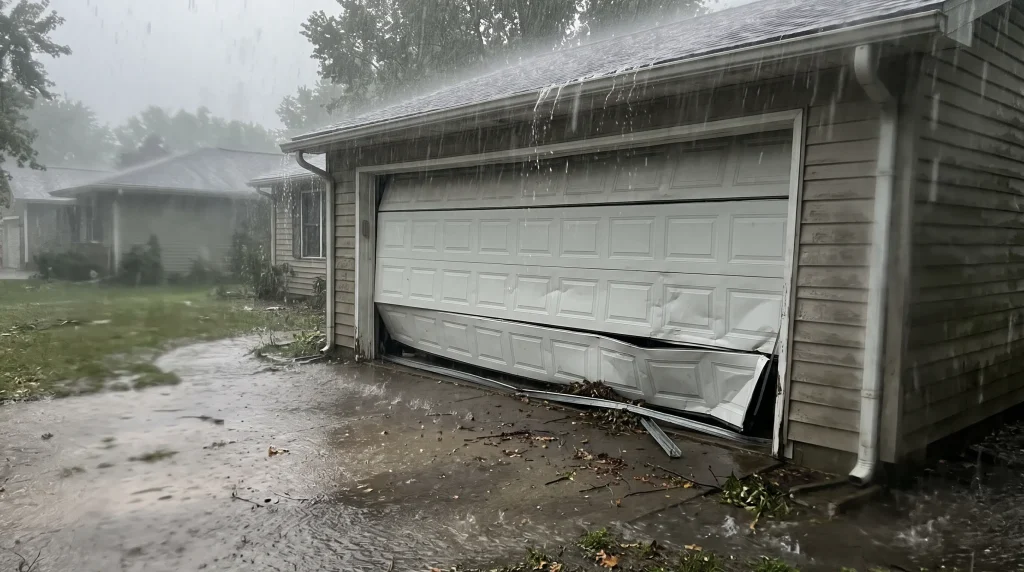
Heavy rain does damage garage doors, but it almost never does it in one dramatic event. It does it over several seasons, through a seal that stopped sealing two summers ago, and the bill arrives as rusted rollers, frayed cables, or an opener that quit. The homeowners who avoid that bill are the ones who do the daylight test twice a year and replace a forty dollar seal before it costs them a section. A consistent garage door maintenance routine catches almost everything on this list while it is still cheap.
If water is getting into your garage and you are not sure which of the seven is responsible, Lincoln Garage Doors LLC can diagnose it in a single visit. Our licensed technicians carry seals, weatherstripping, rollers, and threshold options on the truck, so most water intrusion calls are solved the same day.
Book a garage door inspection or request a free written estimate. Tell us whether the water shows up in ordinary rain or only during storms, since that one detail narrows the diagnosis considerably.