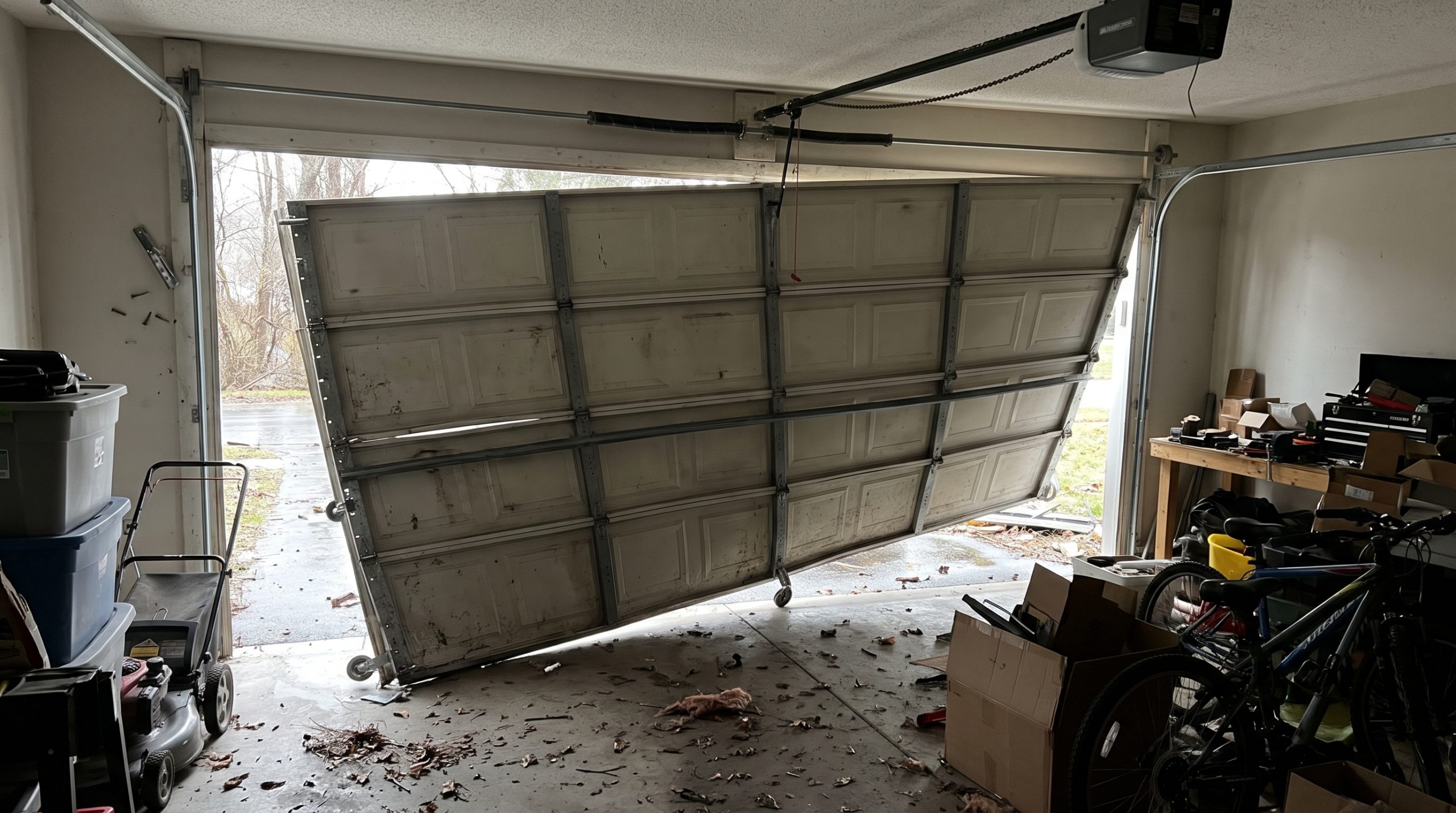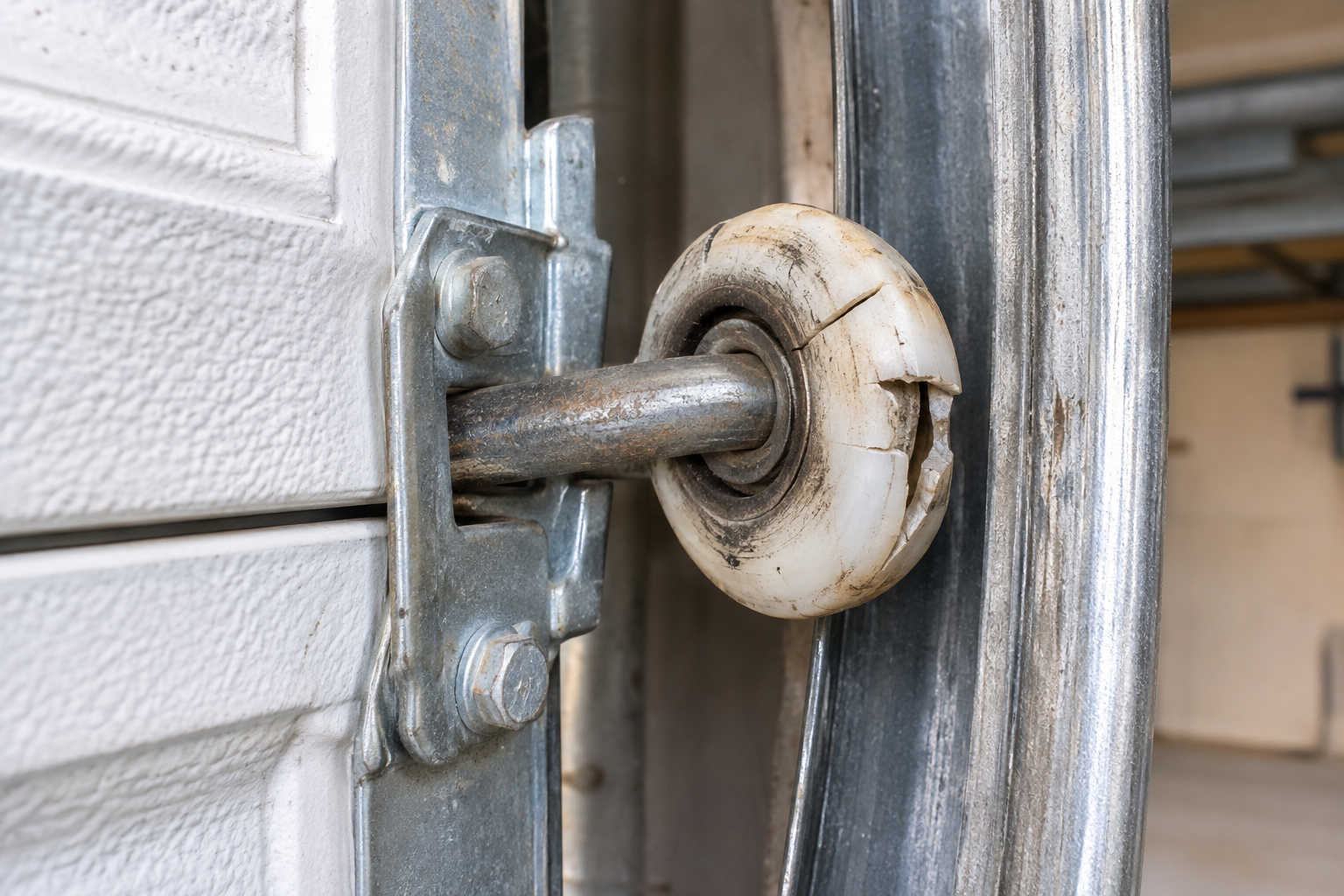
Texas heat damages garage door rollers by degrading the nylon tire on the wheel and drying out the bearing grease inside the stem. In an unconditioned San Antonio garage, summer air sits well above the outdoor high, which softens nylon, hardens old lubricant into a varnish, and expands the steel track just enough to squeeze the rollers as they pass. The result is a door that grinds, hesitates, or drifts sideways. Most homeowners assume the springs are failing. Usually they are not. The fastest way to tell the difference is to disconnect the opener and lift the door by hand: if it holds its position halfway up but feels rough or noisy while moving, the problem is almost always rollers, not springs.
Key takeaways
- Rollers fail from heat far more often than springs do, because nylon and grease degrade with temperature while spring steel mostly degrades with cycle count.
- The clearest test is the manual balance check. A door that holds halfway has good springs. A door that drops or flies up has a spring problem.
- Grinding, scraping, and squealing that gets worse in the afternoon is a roller symptom, not a spring symptom.
- Cracked or flat-spotted nylon tires are visible from the ground. You do not need tools to spot them.
- Roller replacement is a routine, low-cost repair. Spring replacement is not a DIY job under any circumstance.
- Never remove a bottom bracket or attempt spring work yourself. Those components hold enough stored energy to cause serious injury.
Why Texas heat targets rollers before it touches springs
Your garage door rides on eight to twelve small wheels that sit in the vertical and horizontal tracks. Each roller has a steel stem, a small bearing race, and a tire that is either nylon, polymer, or bare steel. Nylon runs quieter and needs less maintenance, while steel is more durable but noisier. You can compare the construction of each part in Clopay’s residential garage door resource library.
Heat attacks all three parts of that assembly.
The nylon tire softens in extreme heat and slowly deforms under the weight of the door. The bearing grease thins, migrates out, and then bakes into a sticky residue that grips instead of rolls. And the steel track expands, narrowing the clearance the roller needs. None of this happens to a torsion spring in the same way. Springs are rated by cycles, not by summers. A ten thousand cycle spring fails when it runs out of cycles, which is why spring failure is usually sudden and loud rather than gradual.
That is the whole reason this distinction matters. Roller wear is progressive and cheap to catch early. Spring failure is abrupt and expensive to ignore. Homeowners who assume every noise is a spring problem tend to either overpay or wait too long.
Here are the seven signs, ordered by how often they show up on a service call.
1. Grinding, scraping, or squealing that gets worse in the afternoon
How to fix a grinding garage door caused by heat worn rollers
A door that runs quietly at 7 a.m. and grinds at 5 p.m. is telling you the problem is thermal. Cold nylon holds its shape. Hot nylon does not.
Most likely cause: the nylon tires have softened and developed flat spots, or the bearings have lost their grease and are now dragging metal on metal.
Fix steps:
- Close the door and pull the red emergency release cord.
- Lift the door by hand about halfway and listen. If the noise is still there with the opener disconnected, it is coming from the door hardware, not the opener.
- Watch each roller as it enters the curve of the track. A healthy roller spins. A failed roller slides.
- Apply a garage door specific silicone or lithium spray to the bearing at the base of the stem, not to the tire and not to the track. If your rollers are nylon, skip lubrication entirely and go straight to inspection.
- Retest. If the grinding is gone, it was dry bearings. If it persists, the rollers need replacing.
Call a pro if: the noise is a deep metallic bang, the door shudders, or you can see a gap in a spring coil overhead. Those are not roller symptoms.
For a full breakdown of every noise a garage door can make and what each one typically costs to resolve, see Why Is My Garage Door Making a Grinding Noise? 6 Causes and What Each One Costs to Fix.
2. Flat spots, cracks, or crumbling edges on the nylon tires
Why garage door rollers crack in Texas summer heat
This is the sign you can confirm without touching anything. Stand inside the garage with the door closed and look at the rollers in the vertical track at eye level.
Most likely cause: repeated heat cycling. The nylon expands every afternoon and contracts every night. Over several summers, that cycle opens hairline cracks in the tire, which then chip away under load.
Fix steps:
- Inspect all rollers, not just the two you can see easily. Failures cluster, because all your rollers are the same age and have taken the same heat.
- Note whether the tire still sits centered on the stem. A tire that has shifted sideways is already past service life.
- Plan to replace the full set rather than one or two. Mixing new and worn rollers puts uneven load on the track.
- Do not attempt to remove the bottom roller. It is held by the bottom bracket, which is under full cable tension.
Call a pro if: any affected roller is in the bottom bracket, or if you find cracks in the door sections themselves rather than just the rollers. Panel cracking alongside roller failure often means the door has been fighting a binding track for a long time, and at that point a garage door replacement may cost less than a series of piecemeal repairs.
3. The door hesitates or stalls partway up when the garage is hot
Why a garage door binds in the heat but works fine in the morning
A door that stops midway on a hot afternoon and then runs normally the next morning is not an opener problem, even though the opener is what appears to give up.
Most likely cause: thermal expansion has tightened the clearance between roller and track, and the opener’s force setting hits its safety limit before the door clears the tight spot.
Fix steps:
- Disconnect the opener and move the door by hand through the point where it stalls. If you feel resistance at the same spot, the track or roller is binding.
- Check that the horizontal track is level and that no bracket has loosened. Vibration plus heat expansion loosens lag bolts over time.
- Resist the urge to increase the opener’s force setting. That does not fix the bind. It forces the door through it and transfers the strain to the cables, brackets, and door sections.
Call a pro if: the door stalls at the same point every time, or the opener reverses immediately after contact. Repeatedly overriding a bind is how a minor roller issue turns into a bent track or a damaged opener. If your opener has already burned out from fighting a binding door, ask about garage door opener installation rather than another repair on a unit that has been overworked.
4. Rollers that wobble, tilt, or jump out of the track
How to tell if a garage door roller is coming out of the track
A roller that no longer sits square in the track is both a symptom and a cause. Once one tilts, it drags the section behind it out of alignment.
Most likely cause: the bearing race has worn oval, usually after the grease dried out. The stem then sits at an angle instead of perpendicular.
Fix steps:
- With the door closed, gently try to move each roller stem side to side by hand. A small amount of play is normal. Visible tilt is not.
- Look for shiny wear marks on the inside of the track, which indicate the roller has been rubbing rather than rolling.
- Check the cables while you are looking. A door that has been running out of alignment often frays a cable at the drum long before anyone notices.
Call a pro if: the door has actually come off the track, or a cable is loose, frayed, or hanging slack. A door off track is under unpredictable tension and can drop. Do not operate it, and do not try to lever it back into place. Frayed or slipped cables need professional garage door cable repair, because the cable is what carries the door’s weight once the springs have done their work.
5. Black or gray dust collecting along the tracks and floor
What black dust on garage door tracks means
Fine dark powder along the bottom of the vertical track is worn material, and it tells you the wear is active right now rather than historical.
Most likely cause: either nylon shedding from failing tires, or steel on steel abrasion from seized bearings. Gray or metallic dust is the more urgent of the two.
Fix steps:
- Wipe the track clean with a dry cloth. Do not lubricate the track. Lubricant in the track collects grit and accelerates wear.
- Recheck in two weeks. If the dust returns, the source is still shedding.
- Build a twice yearly inspection habit. In South Texas, the two natural checkpoints are late spring, before the heat peaks, and early fall.
Call a pro if: the dust comes with visible scoring on the track, or if you find dust below the top roller bracket, which is harder to inspect safely from a ladder.
Late spring is the right time to run a broader inspection, since heat season and storm season overlap here. For a complete seasonal walkthrough, work through What Should Be on Your Garage Door Storm Prep Checklist? 8 Checks Before Texas Storm Season.
6. The door drifts sideways or rubs one side of the opening
Why a garage door rubs on one side after a hot summer
If the gap between the door edge and the jamb is even at the bottom but uneven at the top, the door is tracking crooked.
Most likely cause: rollers on one side have worn faster than the other, usually the side that takes afternoon sun through a window or an uninsulated west facing wall. Uneven heat exposure produces uneven roller wear.
Fix steps:
- Close the door and measure the gap at the top corner on both sides.
- Compare the roller condition on each side. The worn side is usually obvious once you look.
- Check that no track bracket has shifted. Sometimes the track moved, not the rollers.
Call a pro if: the difference is more than about half an inch, or the door binds against the jamb hard enough to leave marks. Industry guidance from the International Door Association recommends a simple look, listen, and learn inspection routine, then contacting a trained professional for anything beyond a visual issue.
7. The door balances correctly by hand but still runs rough
How to tell if it is your garage door rollers or your springs
This is the definitive test, and it is the reason this article exists. Run it before you spend money on anything.
Most likely cause: if the door passes the balance test and still runs rough, the counterbalance system is fine and the problem is in the rolling hardware.
Fix steps:
- Close the door fully.
- Pull the emergency release cord to disconnect the opener.
- Lift the door slowly to about waist height and let go.
- Read the result. A balanced door stays roughly where you left it. A door that slams down has weak or broken springs. A door that shoots upward has springs that are overwound.
- Reconnect the opener when finished.
Call a pro if: the door fails the balance test in either direction, feels extremely heavy, or you can see a visible gap in a torsion spring coil above the door. Do not lift a door with a broken spring, and do not attempt spring work yourself. A residential torsion spring stores enough energy to break bones. This is the single most dangerous component on the door and it is the one job that belongs entirely to a trained technician with the correct winding bars. If the balance test points to the counterbalance system, that is a garage door spring installation job.
Roller wear is not the same across San Antonio
Housing stock changes the failure pattern. Newer subdivisions with larger double doors, west facing garages, and uninsulated door panels see faster nylon breakdown than older homes with smaller single doors and shaded driveways. For a neighborhood level look at how this plays out north of Loop 1604, see What Are the 7 Most Common Garage Door Problems in Stone Oak Homes?
DIY safe vs. call a pro
Task | DIY safe? | Why |
Manual balance test | Yes | No tools, no tension involved. Do this first. |
Visual roller inspection from the ground | Yes | Requires only a flashlight. |
Wiping tracks clean | Yes | Dry cloth only. Never lubricate the track itself. |
Lubricating roller bearings (steel rollers) | Yes | Use garage door lubricant on the bearing, not the tire. Skip entirely for nylon. |
Tightening visible track bolts | With caution | Snug only. Overtightening warps the track. |
Replacing intermediate rollers | Borderline | Possible for experienced DIYers, but a slipped section can pinch fingers badly. |
Replacing the bottom roller or bottom bracket | No | The bottom bracket is under full cable tension at all times. |
Any torsion or extension spring work | No | Stored energy causes severe injury. Requires winding bars and training. |
Cable replacement or re-spooling | No | Improper drum spooling drops the door. |
Reseating a door that has come off track | No | Load is unpredictable and the door can fall. |
Get it checked before the next heat wave
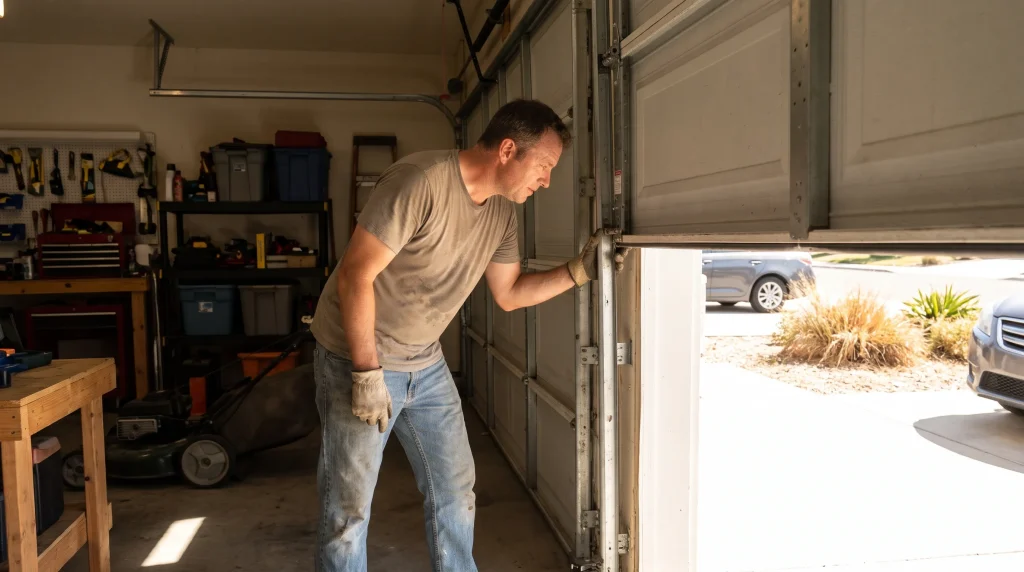
Worn rollers are one of the cheapest repairs on a garage door and one of the most expensive to ignore, because a binding door transfers its strain to the cables, the opener, and eventually the panels. If your door is grinding, hesitating, or drifting after this summer, have the rollers inspected before the damage spreads. Lincoln Garage Doors LLC serves San Antonio and the surrounding communities with same day diagnostics from licensed technicians. Schedule a garage door inspection or request a free quote.